
…sort of. OK, I’ll be the millionth to say it, Japanese is a difficult language to learn. To start with, there are three different ‘alphabets’ that are used interchangeably in sentences. I won’t go into too much detail, but there is more info here.
Fortunately, to make my life a bit easier, I have been mostly focused on spoken Japanese, which is hard enough, but with practice you can become fluent in the important things like figuring out where the bus goes or ordering beer.
The thing that stood out from the beginning is the various ways of counting ‘things’ in Japanese. In English, numbers are numbers, whether it’s stamps, apples, umbrellas, etc. Two stamps, two apples, two umbrellas. Not so here, that would be too easy. In Japanese, things are counted depending upon what type of thing it is. Counting people uses a different counting system than the one used for things that are flat (stamps, paper, shirts). There is another system for things that are long and thin (umbrellas, bottles), and yet another for things that don’t fit any other category (apples, hamburgers).
Two stamps (flat) are ‘ni-mai’ (kitte). Two umbrellas (long and thin) are ‘ni-hon’ (kasa). Two apples (generic) are ‘futatsu’ (ringo). Two people are ‘futari’ (hito). The good news? The noun itself does not change wether it’s singular or plural. Also, there are no definite articles to speak of…it is just ‘apple,’ not ‘the apple’ or ‘an apple.’
But despite the complexity, there are times when Japanese and English overlap. I think there are a couple of reasons for this. The first is that Japan is enamored with American pop culture and sports (especially baseball). The other reason is that many ‘modern’ or ‘foreign’ inventions (modern by the standards of a culture that is very old) are not given ‘native’ Japanese words to describe them.
The easiest example (but contradictory in a way, like many things here) is the thing we walk through many times each day; the door. I say contradictory because ‘doors’ have been around for thousand of years, so one would think that there is a common Japanese word for them and there is. But that word, ‘shoji,’ describes the traditional sliding door made out of a wood frame with paper panels.
The everyday term that is used is ‘doa.’ It is pronounced as ‘doe-ah.’ When I asked the reason why ‘doa’ is used, I was told that the type of door that we are used to, the kind that swings on hinges, is considered a modern and foreign invention. The contradictory part is that the disembodied ladies voice that you hear when riding the elevator (there is almost always an audible confirmation of floor number, door opening, etc.) also uses the term ‘doa’ even though elevator doors slide!
The maddening part is that this pattern is far from consistent. For instance, one would think that the cell phone, being a modern invention, would take on the Japanese version of the English word. Not so. The word for cell phone is ‘keitai’ (kay-tie). The word for a home telephone is ‘denwa.’ Go figure.
So here is a brief list of words that, when pronounced properly, will be understood in Japan:
— Depato (day pah toe) Department Store
— Enjinia (en jin ee ah) Engineer
— Meru-adoresu (may ru add o re sue) Email address
— Supa (sue pa) Supermarket
— Furonto (fu ron toe) Front desk (hotel)
— Hoteru (ho tay rue) Hotel
— Rajio (rah gee oh) Radio
— CD-pureya (CD poo ray ah) CD player
— T-shatsu (T shot sue) T-shirt
— Hotto kohi (hot toe koe hee) Hot coffee
— Taoru (tao rue) Towel
— Teburu (tay boo rue) Table
— Takushi (talk u she) Taxi
— Chekkuin-kaunta (check u in cow un tah) Check in counter
— Gorufu (go rue fu) Golf
— Bagen-seru (bah gen say rue) Bargain (clearance) sale
The last one is my favorite. So that’s a brief journey into the hybrid language that you too can learn to speak.
Here are a few random photos to cap off the post.
-

- Mmmm…nothing like BBQ’d squid at a neighborhood block party.
-

- Donuts (or at least donut-like) with ice cream…now you’re talking.
-

- Cute…a girl at the Nisseki-dori festival with a friend strapped to her back.
-
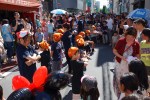
- Dancin’ machines; what they don’t have in dancing moves they make up for with enthusiasm.
-

- Wunderbar (or whatever the Belgian equivalent is). The Belgian beer-fest in Roppongi.
-

- And yet another mascot. Posing with a beer bear (say that three times fast after a few pints) at the Belgian beer festival.
-
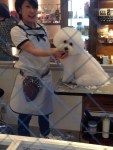
- Puffy. We were watching this fluffy monster get a hair cut through the window and the groomer obliged us with a pose.
-
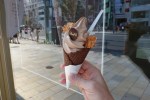
- The best damned ice cream you’ll ever have…so chocolaty.
-
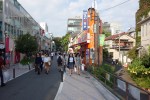
- ‘Cat Street’ in Omotesando…an almost walking mall. Great shopping in perfect late September weather.
-

- Mascots everywhere you look. Amy ‘poses’ with her big-headed friends.
-
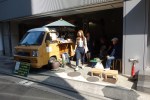
- A mobile coffee stand parked in a garage in Omotesando. You can buy your coffee and keep walking or have a seat and hang out.
-

- Wrestle mania; Amy tries out life as a Sumo star.
-

- The bigger they are…well, the bigger they are. A Sumo wrestler on his way to the arena with game-face intact.
-
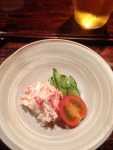
- The art of food…a crab, cucumber, and tomato salad, part of our anniversary dinner at a great restaurant in Azabu-Juban.
-

- A dog’s life. A long-haired dachshund complete with pants and a t-shirt. There are stores here filled with nothing but dog clothes and luxury canine goods.
 Don't Wind Me Up...
You must be logged in to post a comment.